For Writers · Reason 05
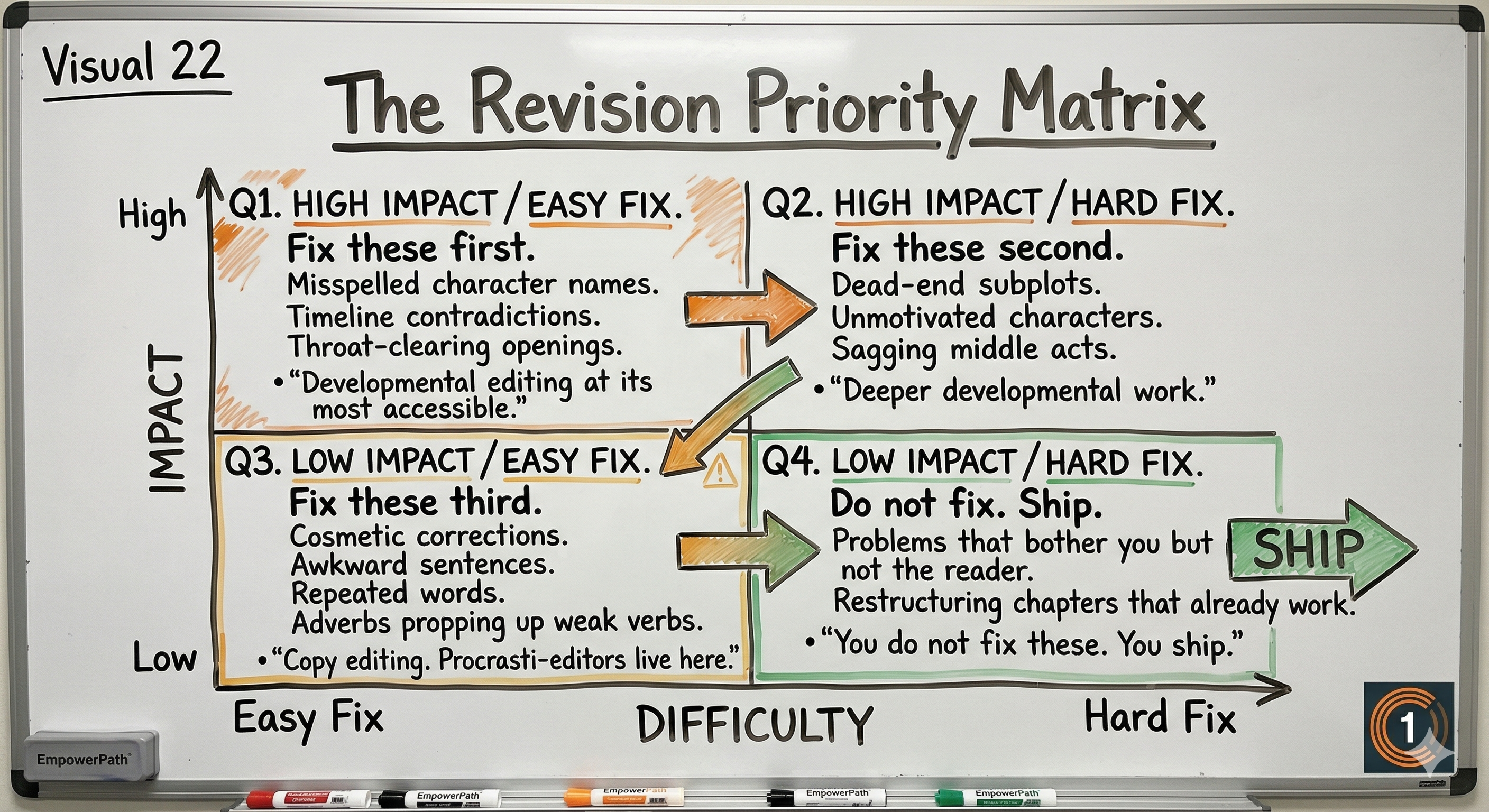
You looked up a comma rule on Thursday and emerged forty minutes later from a discussion thread about whether serial commas signal amateurism. The comma had been right the whole time.
You read a two-star review of someone else's book on Wednesday and spent forty-three minutes building a spreadsheet to audit your own manuscript for the same flaw.
Your beta reader sent feedback a few months ago. You implemented every suggestion. You have rewritten the chapter four times since. The feedback document is open in another tab. You are going to read it again.
You finished the manuscript last season. You told your spouse it was done. Then you went back a few weeks later to "just polish a few things." Months passed. You have rewritten Chapter One six more times.
Your revision notes are color-coded. The colors have a key. The key has been updated three times this month. You are using purple now. You used to use teal.
You spent an hour and a half this morning reorganizing the chapter outline. The outline did not need reorganizing. The chapter did not need reorganizing. You needed something to do that felt like writing without being writing.
You wrote a sentence a few seasons ago that made you cry. You revised it the following month. You revised it the month after. The version that made you cry is in the version history. You have not gone back to look at it.
If your stomach just clenched, you are in the right room.
We know. When you can't finish your novel because Chapter One won't let you go, the page is not the problem. The alarm at the page is. We have done every one of these. We have a folder of "polishing passes" with date-stamped revisions to prove it. So has Sarah, the writer in our book whose Chapter One has been edited eleven times, whose color-coded matrix produced zero new pages, and whose pattern this pillar is named after.
Rewriting Chapter One is the most common form of writer-perfectionism in the unfinished-manuscript landscape. It is also the most flattering disguise the alarm has ever worn. The honest names you have probably given it — I'm a careful writer. I have high standards. I just want it to be right. The first chapter has to land. — are not entirely wrong. They are also not what is happening.
What is actually happening is your alarm.
Rewriting Chapter One is your alarm in Standard-Setter costume
In Circle 1 Living language, Standard-Setter is the SPARK persona that wears Freeze as a mask. Where Adventurer freezes by jumping to a new project, where Reserved freezes by hiding in plain sight, where Provider freezes by giving the time away, where Knight freezes underneath aggression — Standard-Setter freezes by raising the bar so high that nothing gets past the gate. The standard is not the work. The standard is the wall.
Standard-Setter is the most common mask among writers who never finish.
It does not feel like freezing. It feels like discipline. It feels like quality control. It feels like I just need one more pass before this is ready. The pass is real. The polish is sometimes real. The improvement is occasionally real. None of that is the diagnostic.
The diagnostic is the timing.
Standard-Setter never freezes at the beginning of a draft. Standard-Setter freezes at the door of good enough — the moment the chapter could be sent to a beta reader, the moment the manuscript could be queried, the moment the work could be evaluated by anyone outside the writer's own head. The wall does not exist when the work is private. The wall is only built where exposure begins.
The Grade-Chaser does not avoid writing. The Grade-Chaser avoids finishing.
That is the Sarah line from our work. She had eleven drafts of Chapter One. She had zero drafts of Chapter Two. The eleventh edit was not improving the chapter. The eleventh edit was buying her one more week of not having to be evaluated on Chapter Two.
Three things about perfectionism nobody puts on a writing podcast
The eleventh edit is not improving the work. It is buying the writer one more week of not having to be evaluated on it. The chapters that get to ten drafts and stop are usually only marginally better than the same chapters at three drafts. The improvement curve flattens early. What keeps going is the avoidance.
Spreadsheets do not get rejected. Manuscripts do. The matrix you are about to build to "audit" your prose, the color-coding system you are about to design for your revision passes, the new productivity app you just downloaded to "stay on track" — all of it is real-feeling work. None of it is at risk of being read by a stranger and called dry. The alarm is steering you toward effort that cannot fail because nobody outside your kitchen will ever see it.
The cure is not "lower your standards." That is the most common bad advice given to writers stuck on Chapter One, and it is wrong. Your standards are fine. Most Standard-Setters have excellent taste. The problem is not the standards. The problem is the diagnostic — the inability to tell which revisions are serving the reader and which are serving the alarm. The cure is mechanical. It is called Hard or Wrong.
The Hard or Wrong diagnostic
In Chapter 5 of our book the facilitator writes two words on the whiteboard:
HARD. WRONG.
Here is the distinction.
Hard is work that asks something risky of you. The confrontation scene you do not know how to write. The chapter that requires you to be honest about something painful. The query letter that has to be sent to a stranger. Hard scares you.
Wrong is work that does not serve the story. The fifth round of edits on Chapter One when the manuscript needs a draft of Chapter Twelve. The folder system that looks like progress. The comma rule lookup that ate forty minutes. Wrong bores you.
Hard scares you. Wrong bores you. Same uniform. Not the same animal.
Standard-Setter has trained you to call all friction "the work being hard." It is not. The eleventh edit is not hard. It is wrong — wearing hard's costume. Once you can tell them apart, the eleventh edit stops being negotiable. You either notice you are bored and walk away, or you continue and watch yourself perform the ritual without believing in it. Either way, the alarm loses the disguise it has been hiding behind.
The diagnostic is a single question you ask before every revision pass:
Did this revision make me feel safer, or did it make the work better?
If safer — the Standard-Setter is running the show. Stop.
If better — continue.
If both — ask the second question. Would a reader at 2 AM, in bed with a glass of water on the nightstand, notice this change? If no, stop. If yes, continue.
Worth lives in Circle 1
Circle 1 Living teaches three concentric rings. Circle 3 is what you cannot control — what reviewers will say, whether agents will accept the manuscript, what readers will think when they get to Chapter One. Circle 2 is what you influence. Circle 1 is what you control — your effort, your attitude, your response when the alarm fires.
Worth lives in Circle 1. Nowhere else.
The eleventh edit is a Circle 3 promise — if I just polish this one more time, the reviewers will be kind, the agents will say yes, the work will land. Worth has never lived in the eleventh edit any more than it lived in the third. Every writer who has ever finished a manuscript finished it because they stopped negotiating with the alarm about polish and started writing the next chapter. The polish was always downstream. It was never the door.
The 5% who finish are not less rigorous than you. They have just gotten faster at telling Hard and Wrong apart.
What to do this week
Three moves, in order:
The first move is the Pattern Spotter. Twenty minutes. One page. Surface the specific revisions, lookups, reorganizations, and "polish passes" your alarm has been calling craft over the last ninety days. Not the feelings. The behaviors. The Tuesday you reorganized the outline. The Wednesday you built the spreadsheet. The Thursday you spent forty minutes on a comma rule that was right to begin with. Naming the behaviors is what makes them interruptable. The alarm cannot survive being seen on the page next to its receipts.
The second move is the Hard or Wrong diagnostic. Apply it before every revision pass for the next seven days. One question, two if needed. Did this make me safer, or did this make the work better? Then would a reader at 2 AM notice the change? Track the answers in a notebook for the week. By Sunday, the pattern will be visible without you having to interpret it.
The third move is the 15-minute test. When you sit down to write the next chapter and the urge surfaces to "just polish Chapter One first," check your watch. Have you been on the next chapter for less than 15 minutes? If yes — you are not recalibrating. You are running. Stay. Write a bad sentence. Then another. The chapter you are avoiding will not write itself, and the chapter you are polishing has nothing left to give you that ten more passes will not also give it.
Where this wound shows up next door
If perfectionism is firing for you outside the manuscript — at work, in a launch you cannot ship, in a thank-you note that has been sitting in drafts for months — the same wiring is doing the same job. The universal version of this pattern is here: Why I can't stop perfecting it →.
The closest cousin to the perfectionism trap is the craft wound — the voice that says my sentences aren't good enough. Same SPARK family (Standard-Setter), same alarm, different angle. Many writers run both at once — perfecting Chapter One while telling themselves the underlying problem is that the prose is weak. If both fire for you, Read: My sentences aren't good enough →.
Close
Chapter One is not waiting for one more revision. It is waiting for you to write Chapter Two. The 5% who finish are the writers who recognized the eleventh edit for what it was, set the chapter down without ceremony, and opened a new document with a higher number on it. The book got finished. The reviews came. None of them were about the comma. None of them ever are.
The fastest way to start that pattern is to surface the alarm in writing.
Related: Complete your novel now →
If you'd rather start with the diagnostic that names which mask your alarm wears, the SPARK Persona Quiz is three minutes, ten questions, and built specifically for this.
If you'd rather see the pattern in someone else first, the opening of Circle 1 for Authors is free →. Sarah's eleventh edit appears in one of the early ones.