For Writers · Reason 01
You finished the first draft a few months ago. Months have passed. You have not told one person it exists.
When your sister asked what the book was about, you said "it's complicated." It is not complicated. It is yours.
You filled out a contest entry form last week. You stopped at the field that says Author Bio. You closed the tab.
You introduced yourself at a writing meetup last month as "someone who writes a little." You have a 67,000-word manuscript on your hard drive.
You read the opening paragraph of a published book in your genre yesterday and put it back on the shelf. You whispered "I can't do that" — and you were not whispering about the prose. You were whispering about the permission.
You bought a notebook with the word WRITER embossed on the cover. You hid it in the bottom of your nightstand drawer because you didn't want anyone in your house to see it and ask.
You are forty-seven and a half. You have not let yourself want this since you were twenty-six.
If your throat tightened on any of those, you are in the right room.
We know. We have done every one of these. We have a folder of unsent contest entries and a notebook with a hidden cover to prove it. So has every writer we know who has gotten honest about it. So has every author we know who has ever finished anything. This is what imposter syndrome for writers actually looks like — not the slick TED-talk version, the kitchen-table version.
The question who am I to write a book is the most common opening sentence of a quitting story. It does not feel like quitting when you say it. It feels like humility. It feels like realism. It feels like knowing your place. None of those are honest names for what is actually happening.
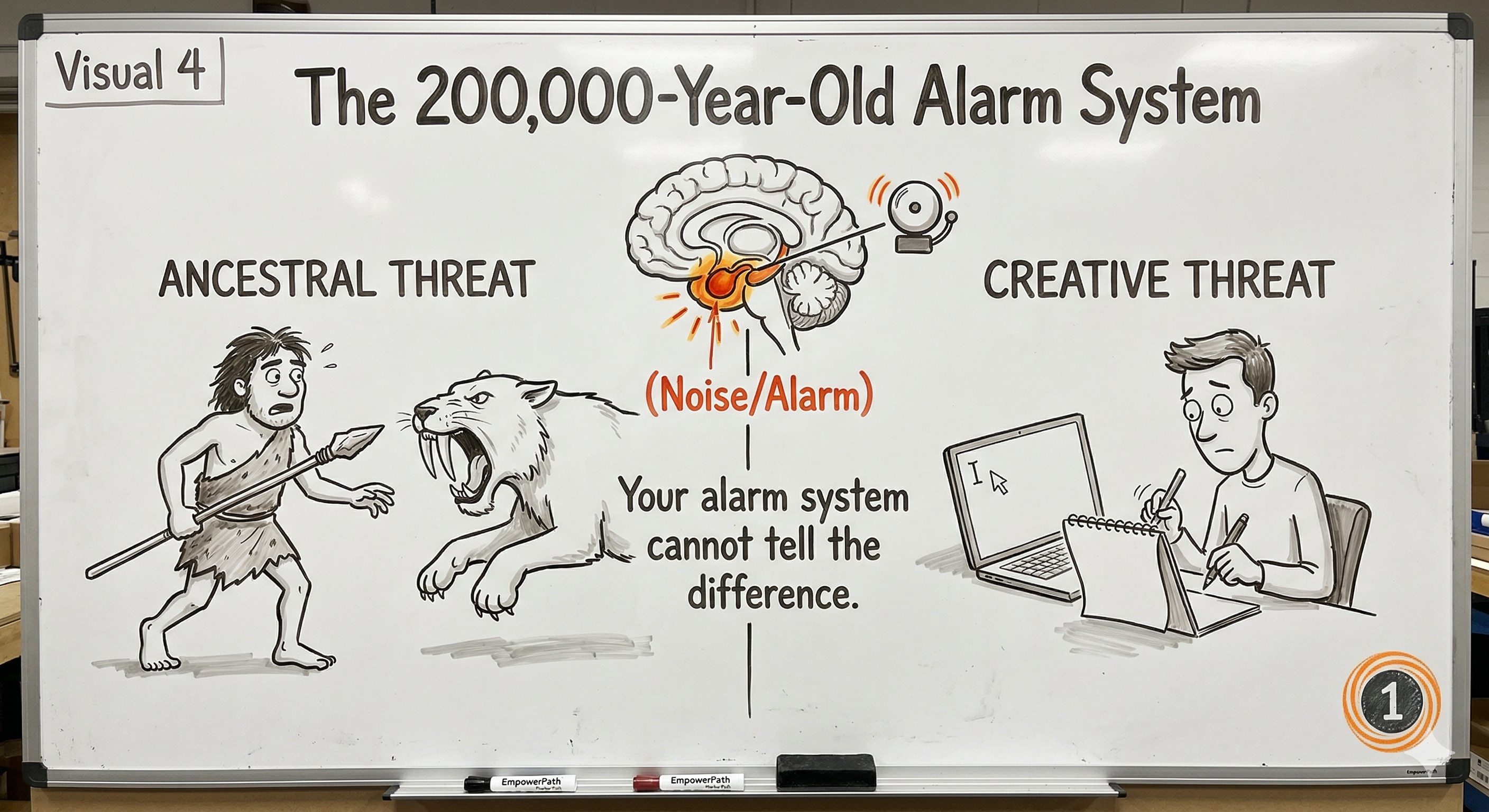
What is actually happening is your alarm.
The imposter wound is not a confidence problem
The imposter wound is not solved by your degree. It is not solved by your portfolio, your platform, your three best Substack posts, or the list of accomplishments your spouse keeps trying to remind you of. Every writer who has ever walked this same road has tried solving it that way. The alarm was waiting on the other side of every credential.
Here is what is actually happening underneath the question who am I to write a book.
Somewhere between the ages of four and twelve, your nervous system learned that taking up space was unsafe. Maybe a parent rolled their eyes at your story. Maybe a teacher said "stop showing off." Maybe you watched a sibling get punished for being too loud, too smart, too visible — and you took the safer side of the lesson home with you. The body kept the receipt.
That receipt is what fires now when you sit down to write a book.
Writing a book is the loudest claim a private person ever makes. I have something to say. I am willing to put my name on it. I want this to exist in the world long enough for strangers to argue with it. Your alarm hears that claim and reaches for the oldest move it has — the one that kept the four-year-old safe.
It calls that move "humility." It calls it "realism." It calls it "knowing my place." It calls it "I'm not ready yet." None of those are honest names for what is actually happening. The honest name is freeze — and in our work the costume freeze wears most often, when the imposter wound runs the show, is the SPARK persona we call Reserved.
Reserved is the writer who hides in plain sight. The Reserved writer can describe everyone else's manuscript at the workshop. She has not described her own. The Reserved writer reads three books on craft for every page she writes and tells herself this is preparation. It is the alarm in costume. The costume is winning.
The imposter wound shows up in other masks too. Provider writers solve it by writing useful books instead of true ones — the alarm steers them toward "helpful" so it does not have to risk "honest." Knight writers solve it by going to war with the gatekeepers — the publishing industry doesn't want writers anymore — which is the imposter wound dressed up as critique. The mask you wear matters. So does the page you sit down to write. And the page gets a lot easier when you put a real human on the other side of it.
Three things about the imposter wound nobody puts on a podcast
The voice does not go away. It can be trained to wait. It cannot be evicted. Every writer in the 5% who finish is finishing alongside a voice that says who do you think you are. The 95% who quit are the ones who believed the voice was reporting a fact instead of running a script.
Credentials do not quiet it. They feed it. Every certificate you collect to "earn the right" gets metabolized into a new threshold the alarm has to clear. You have an MFA. So does she. You have ten years of experience. So did the one who got rejected. The wound is not a math problem. You cannot out-résumé it.
The cure is mechanical, not philosophical. The work is to recognize the alarm by name, give it the few seconds it needs to fire, and put your hand on the keyboard anyway. There is no insight that bypasses this step. There is no breakthrough conversation. There is no morning you wake up healed. There is the alarm, and the keyboard, and the chapter that gets written while the voice is still talking.
Worth lives in Circle 1
Circle 1 Living teaches three concentric rings. Circle 3 is what you cannot control — what people think of your book, what reviewers will say, which gatekeepers will sign off, what the algorithm will do. Circle 2 is what you influence — the people you show up for and the energy you bring when you do. Circle 1 is what you control — your effort, your attitude, your response when the alarm fires.
Worth lives in Circle 1. Nowhere else.
The imposter wound's whole sales pitch is that worth lives in Circle 3 — what other people think you've earned the right to do. That sales pitch is wrong. Not because it is mean. Because it is mechanically wrong. Worth has never lived in Circle 3 for any writer in human history.
The day Toni Morrison started writing The Bluest Eye, no reader had told her she was allowed to. The day Stephen King started Carrie, his teaching colleagues thought he was wasting his time. Every writer who has ever finished a book started by quietly deciding worth lived in Circle 1. That is not motivational language. That is the wiring. The 5% are wired this way because they made one decision the 95% are still waiting for permission on. And the permission, it turns out, was never coming from outside.
What to do this week
The first move is naming the one reader. Open the worksheet. Write down a specific person — not "young women in their thirties," not "people who are stuck." A name. A first name. The kitchen she is sitting in at six in the morning. The mug in her hand. The sentence she needs to read that nobody is writing yet. The imposter voice can argue with an audience. It cannot argue with Amy.
The second move is naming the specific behavior. Open a notebook. Write down the last three times the imposter wound made a decision for you that cost you a chapter, a query, an introduction, a workshop signup, a meetup name tag, a moment when you could have said "I am writing a book" and didn't. Specific behaviors, not the feeling. The behavior is what you can interrupt. The feeling is just the weather.
The third move is the ten-second window. Next time you sit down to write, set a timer in your head for ten seconds before you open the manuscript. Watch what your body does in those ten seconds. Tightening jaw. Held breath. Hand drifting to the phone. Inbox check. That is the alarm firing in real time. Once you can see it, you can wait it out. The alarm peaks in seconds and resolves on its own — if you do not feed it.
The 5% who finish are not braver than you. They have just gotten faster at the ten-second wait.
Where this wound shows up next door
If the imposter wound is firing for you in places besides the manuscript — at work, at parent pickup, in a new role — the same wiring is doing the same job. The universal version of this pattern, with scenarios from outside the writing life, is here: Why do I feel like a fraud? →.
The cousin to the imposter wound is the worth wound — the voice that asks why would anyone want to read this? rather than who am I to write it? Same family, different angle. If both fire for you, Read: Who would want to read my book? →.
Close
Writing a book is not about earning the right. There is no ceremony. There is no committee. There is no moment when the universe taps you on the shoulder and says now. The 5% who finish are the writers who stopped waiting for the tap. They wrote the chapter while the voice was still asking who do you think you are. The book got finished anyway. So did the voice — eventually, quieter, in a smaller chair near the back of the room.
The fastest way to make that happen is to put a name on the page.
Related: What is imposter syndrome for writers →
Related: How to overcome writing self doubt →
If you would rather start with the story, the opening of Circle 1 for Authors is free →. The chapter that ends with Sarah in the parking garage. Foot on the brake. Manuscript in the bag.
If you want to know which mask your imposter wound is wearing while you fill out the worksheet, the SPARK Persona Quiz → is ten questions, three minutes, and tells you whether the alarm runs Reserved (most common in this wound), Provider, or Knight.