For Writers · Reason 04
You can describe your target reader's age bracket, household income, favorite podcast, and zodiac sign. You cannot tell us her name.
You can quote the one-star review of someone else's book word for word. You cannot quote a single line from the book you are writing right now.
You spent forty minutes reading Amazon reviews of three published books in your genre this morning. You did not spend forty minutes thinking about who needs the book you are writing.
Your literary agent's bio says she is "looking for stories that travel." You revised your query letter to use the word travel three times. You no longer remember which character travels in your book.
You finished a chapter that made you cry. Your spouse asked who would read it. You said "I don't know" and felt the cry-feeling shrink to a small flat thing.
You read a magazine article about a book that sold 4 million copies. You went back to your manuscript and revised the opening to sound more like that book. The opening was better before.
You can see one specific person who needs your book. You can describe her kitchen. You have not said her name out loud, including to yourself.
If your throat tightened on any of those, you are in the right room.
We know. When the question should I write a book keeps looping, it is rarely a real question. It is the worth wound asking for permission. We have done every one of these. We have a detailed reader-avatar document with eleven demographic fields and zero names to prove it. So has Sarah, the writer in our book whose business book sat in a folder for two years until she stopped writing for "the audience" and started writing for one person named Amy.
The question who would want to read my book is the second-most common opening sentence of a quitting story among writers who have actually written something. (The first is my writing isn't good enough.) Both wounds are about worth. Both run through the same alarm. The worth wound is what fires when the writer cannot picture who is on the other side of the page.
What is actually happening is your alarm.
The worth wound is your alarm in Reserved costume
In Circle 1 Living language, the question who would want to read my book is your alarm in Reserved costume. Reserved is the SPARK persona that wears Freeze as a mask. Reserved freezes by hiding in plain sight — the writer who can finish a chapter and not let another human read it for eight months, the writer who has a publication-ready manuscript and tells exactly zero people it exists, the writer who cannot picture a single reader because picturing one would require letting the book out of the safety of her own head.
Reserved is one of the two most common masks among writers who can write but cannot finish.
It does not feel like freezing. It feels like research. It feels like I just need to figure out who this is for. It feels like an audience problem that more market research will solve. It is not. The market research is the avoidance. The audience-shaped question is the alarm.
What is actually happening underneath the question is a fuel problem.
In Chapter 2 of our book, the facilitator distinguishes two kinds of Why a writer can have. Ego-Why sounds like I want to be a published author. I want to walk into a bookstore and see my name on the spine. I want my mother to take me seriously. Service-Why sounds like there is a girl who has never seen herself in a love story with a happy ending, and I am writing one for her. There is a middle manager who has been told for years that leadership books are for executives, and I am writing the book that says no, this one is for you.
Both are real. Neither is morally superior. The difference between them is mechanical.
Ego-Why is sugar. A fast spike when you imagine the book deal, the five-star review, the bookstore-spine moment. Then a crash, when nobody is clapping at page 150. Service-Why is protein. Slow, steady, sustained. The reason you keep writing on the Tuesday when nobody is watching, when the manuscript has lost its glamour, when the only thing left is the next paragraph for one specific person who needs it.
The worth wound runs the writer's fuel system on sugar. The wound asks who would want to read this? and the alarm processes the question through Ego-Why filters — who will buy it, who will review it, who will recommend it. All of those answers live in Circle 3, outside your control. The fuel runs out on schedule. The writer concludes she has no audience. She does not. She has been running on the wrong fuel.
The Service-Why answer to who would want to read this? is not a demographic. It is one specific person, in one specific room, holding one specific feeling, who needs the thing the writer is making.
Sarah's Amy
In our book, Sarah spent two years writing a leadership book for "ambitious professionals aged 32 to 45 with corporate experience and a side interest in personal development." That sentence is real. It was on the title page of her book proposal. It is also the reason her book did not get finished for two years.
The day Sarah's book started moving was the day she stopped writing for that sentence and started writing for Amy.
Amy is twenty-eight. Amy works on the third floor of an office building. Amy has a yellow legal pad on her desk. Amy is holding a coffee mug she has not put down in fifteen minutes — because if she puts it down, she will have to start the meeting she has been dreading. Amy has read three other leadership books that did not help her. Amy is sitting in her car for nine minutes on a Tuesday afternoon trying to figure out whether to drive to the coffee shop or drive home.
Amy is the reason Sarah's book exists.
When Sarah's alarm fires now — when she opens the manuscript and the worth wound asks who would want to read this? — she does not answer with a demographic. She asks: what does Amy need on page sixty-eight? The wound stops firing because the question changed. Worth is no longer in Circle 3 (where the wound put it). Worth is in Circle 1 (where Service-Why anchors it).
This is the move. Name your one reader. Not a market segment. Not a list of three comparable authors. One human, in one room, holding one feeling, whose life will be different because the book exists. Most writers have already half-imagined this person and not let themselves admit it. The next move is to write her down.
Three things about the worth wound nobody puts on a writing podcast
The "ideal reader avatar" you have been told to build is Ego-Why dressed up as marketing strategy. A demographic profile is not a reader. A demographic profile is a research project. Most demographic profiles cannot sustain a chapter, because the alarm cannot picture them holding the book — and the alarm needs to picture someone holding the book to release the fuel that finishes it.
The reader does not have to exist yet. The reader has to be specific. Patrick, in our book, wrote his fantasy novel for his eleven-year-old grandson Leo, who needed a quest. Ruth wrote her memoir for the women in kitchens who never told anyone what they carried. Amy was real. Leo was real. The grandmother Ruth wrote for lived inside her imagination. Specificity is the diagnostic. Existence is not.
The cure is not "find your audience." The cure is name your one reader. The 5% who finish are the writers who can describe their reader's kitchen. Not her demographic. Her kitchen.
Worth lives in Circle 1
Circle 1 Living teaches three concentric rings. Circle 3 is what you cannot control — who will buy the book, who will recommend it, who will write a review, whether the algorithm will surface it to the readers who need it. Circle 2 is what you influence. Circle 1 is what you control — your effort, your attitude, your response when the alarm fires.
Worth lives in Circle 1. Nowhere else.
The worth wound's whole sales pitch is that worth lives in Circle 3 — that if you can just predict and pre-manage the audience, the book will arrive safely received. It cannot. The audience is not yours to manage. It has never been yours to manage. Every writer who has ever finished a book wrote it for someone she could see clearly — and let everyone else who eventually read it be a downstream effect of the decision to write for the one. The one was always Circle 1. The audience was always Circle 3.
The 5% who finish are not better at audience-targeting than you. They have just gotten faster at naming their one.
What to do this week
Three moves, in order:
The first move is to read someone else's book and notice who they wrote it for. Open the free sample of Circle 1 for Authors (link below). Read the opening. Notice who Sarah is. Notice that the chapter is not written for "ambitious professionals aged 32 to 45." It is written for Amy. The specificity is in the prose. Once you can see it on someone else's page, you will see it on your own.
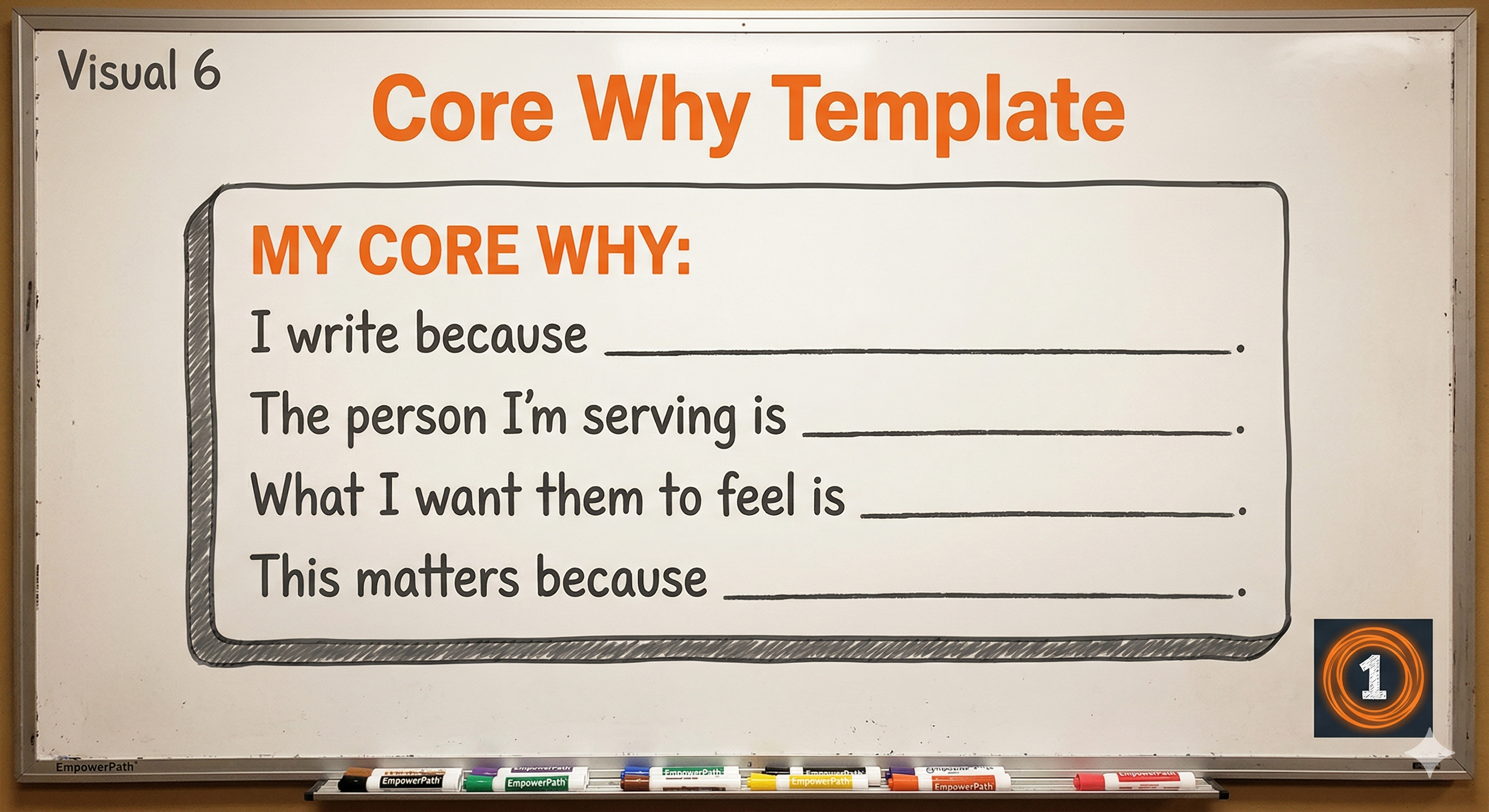
The second move is to name your one reader. Open a notebook. Write the name of one specific person — first name only is fine, real or imagined — for whom your book is the answer. Underneath the name, write three things: where this person is sitting when she reads the first chapter (be specific — the kitchen counter at 5:47 AM with the cold coffee, the bus seat on the way home with the headphones on), what she is afraid of right now that the book speaks to, and one sentence she might say out loud at the end of Chapter Five. If you cannot finish those three things, the reader is not specific enough. Keep writing until the room comes into focus.
This is the Two Letters exercise from Chapter 2 of our book, compressed. The full exercise is two letters — one written to the thing nobody warned you about (Ego-Why surfacing) and one written to the person whose life will be shaped by what you finish (Service-Why anchoring). The second letter is the one you keep next to your writing space. When the worth wound fires, you read it before you decide whether to close the laptop.
The third move is the SPARK Persona Quiz. Three minutes, ten questions. Reserved is one of two common masks for the worth wound; Provider is the other. The Provider version of the wound translates the book — softens it, makes it useful, makes it palatable — to manage the response. The mask matters. The wiring underneath each one is different.
Where this wound shows up next door
The worth wound and the imposter wound are sister patterns inside the alarm. Where the worth wound asks who would want to read this, the imposter wound asks who am I to write it. Different questions, same family. Many writers run both at once. Read: Who am I to write a book? →.
If the same wound is firing for you outside the writing — in a job, a project, a piece of work where you cannot picture who would want it — the universal-hub pillar that addresses the closest cousin of this alarm is here: Read: Why do I feel like a fraud? →.
Close
The audience is not yours. It has never been yours. The one specific reader is. She is sitting somewhere right now — in a kitchen, in a car, on a bus, in a hospital waiting room — needing exactly the thing you are afraid you cannot write. The 5% who finish are the writers who decided to write for her, by name, instead of writing for the abstract audience who would never love them back. Sarah's Amy emailed three years after the book was published. I needed that chapter to exist. That email is the only review that ever mattered.
The fastest way to start is to find your Amy.
If you'd rather find which mask your alarm wears before you read, the SPARK Persona Quiz is three minutes, ten questions, and built specifically for this.
If you have read enough to know you want to be in the room while the manuscript is being finished, Founding Readers applications → are open until the seats fill. One hundred and fifty seats. Read the book before it publishes. Tell us what lands. That is the entire ask.