For Writers · Reason 07
You finished the first draft eight months ago. You have not let another human read a sentence of it.
You belong to two online writing groups. You have not posted in either of them since spring. You read everyone else's work and leave thoughtful comments. You have not shared a paragraph of your own.
You have a critique partner from a workshop two years ago. She has emailed you three times in the last few months. Her last email said I miss our exchanges. You have drafted four replies. You have sent zero.
You attended a regional writers' conference last season. You spoke to three people. You left every business card in your hotel room.
You bought a "writing community" course online a few months ago. You have not opened the welcome email. The community link is in the email. The link expires next month.
You told your spouse last week you were "almost done with the book." It has been "almost done" for months. He asked if anyone else has read it. You changed the subject.
You wrote a chapter last season that you knew, while writing it, was the truest thing you had ever written. You closed the document. You opened it once a few months later. You have not opened it since.
If your throat tightened on any of those, you are in the right room.
We know. Writing a book alone is one thing. Staying alone past the tipping point is another. The body knows the difference long before the mind does. We have done every one of these. We have a folder of unsent emails to a critique partner who is still waiting to be replied to. So has Ruth, the writer in our book whose grandmother kept three blank binders on her nightstand for sixty years — and whose pattern this pillar is named after, even though Ruth's wound did not look like writers' isolation at first. It looked like being useful. It looked like making space for everyone else's words so there would not be room for her own. It was the same wound.
The conviction that I'm writing alone is the most invisible wound in the unfinished-writer landscape. It is also the most likely to be misnamed as introversion, professionalism, focus, or I just need to finish the manuscript first. None of those are honest names for what is happening. The honest name is being seen has cost me something before, and my body remembers.
What is actually happening is your alarm.
Writing alone is your alarm in Reserved costume
In Circle 1 Living language, the wound of writing alone is your alarm in Reserved costume. Reserved is the SPARK persona that wears Freeze as a mask. Where Adventurer freezes by jumping to a new project, where Standard-Setter freezes by raising the bar, where Provider freezes by giving the time away, where Knight freezes underneath aggression — Reserved freezes by hiding in plain sight. The wound stays clean because nobody is given access to test it.
Reserved is the most invisible mask among writers who never finish.
It does not feel like freezing. It feels like introversion. It feels like I work better alone. It feels like I'll share when it's ready. It feels like protecting the work, protecting the writer, protecting the relationship between the two. None of those are the diagnostic. The diagnostic is the cost.
The cost is that the manuscript exists and the reader-relationship does not.
A book that nobody has read is not a book yet. It is a Word document. The only thing that turns it into a book is the moment another human carries the words inside themselves and is changed by them. The Reserved writer can have a complete manuscript and still be on page one of authorship — because the audience of one (herself, reading her own page) cannot make the book real. Writing alone protects you from being misread. It also guarantees the book will not be read.
This is the wound's central lie. It tells you that hiding the work is the careful version of being a writer. It is not. It is the alarm version.
What is actually happening underneath
Two hundred thousand years ago, your nervous system learned that being seen could be dangerous. Not because every visibility was a threat — but because the cost of being seen by the wrong person, in the wrong room, was high enough that the body's wiring developed a default toward invisibility. Better to stay quiet and survive than to speak up and be banished from the tribe.
That wiring is still in your body. It is firing now, every time you draft an email to your critique partner and do not send it. Every time you read someone else's work in the writing group and decide your own paragraph is not ready. Every time you finish the truest chapter you have ever written and close the document instead of letting another human carry the sentences for an hour.
The wiring is doing its job. The wiring is also working with information that is two hundred thousand years out of date. There is no tribe waiting to banish you for sharing a chapter. There is just one person, on her phone, on a Tuesday, who would read your paragraph and either understand it or not, and either way return to her own life within minutes — leaving the bridge between you stronger or unchanged. Either outcome is survivable. Both are bridges.
The Reserved writer's alarm cannot tell the difference between a bridge and a banishment. Your job is not to argue the body out of it. Your job is to recognize when the wiring is misfiring and walk one rung onto the bridge anyway.
The Visibility Ladder (and Ruth's correction)
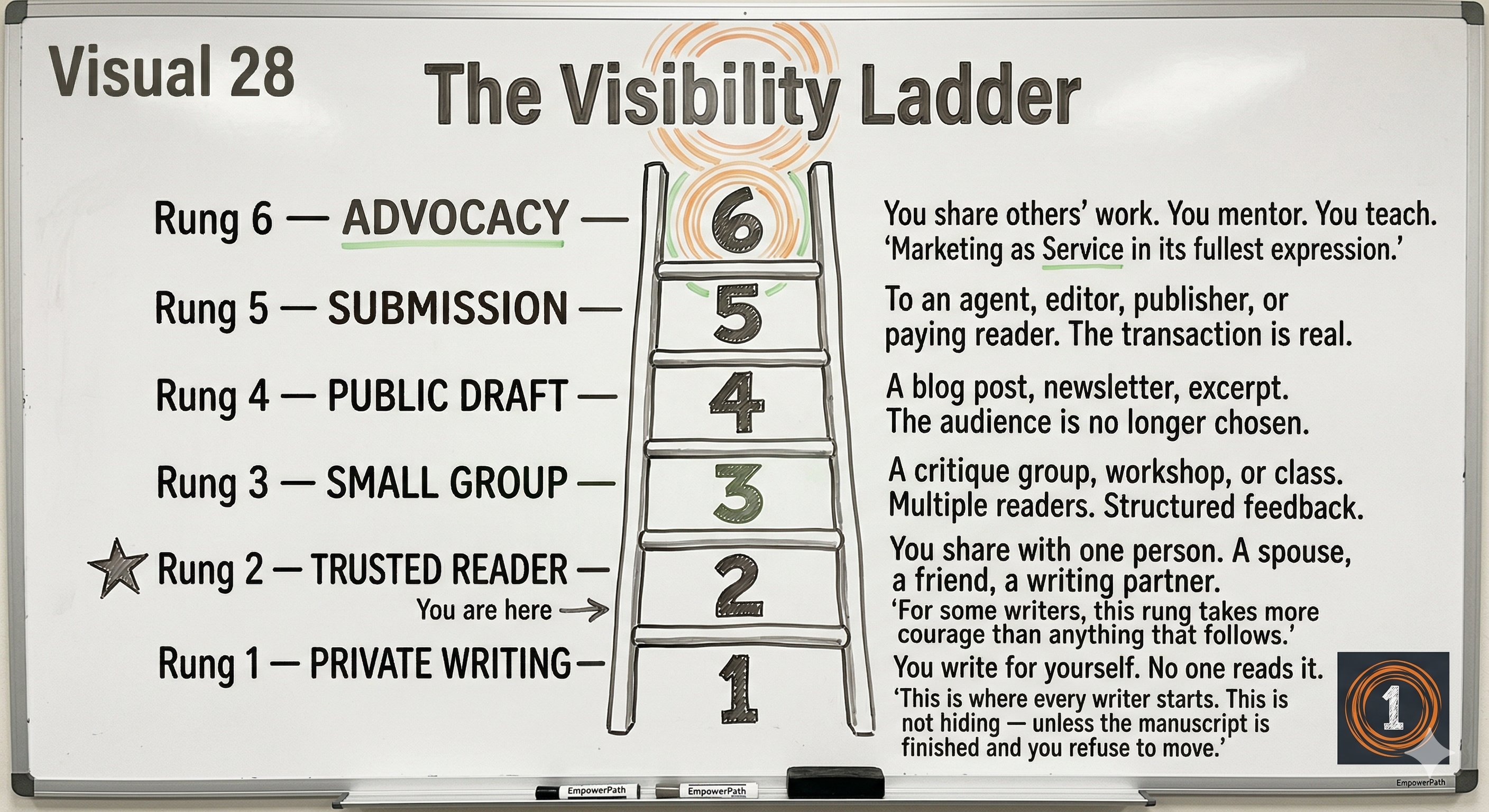
In Chapter 14 of our book, the facilitator draws a Visibility Ladder on the whiteboard. The Ladder is the workshop's framework for building the muscle of being seen — rung-by-rung, smaller than the alarm can object to. Each rung is a small step further into being witnessed by one more person, in one more setting, with one more piece of the work.
The Ladder is the practical structure for moving out of writing alone. But the most important thing about it is not the rungs. The most important thing is what Ruth said about it.
When the facilitator drew the Ladder going up — the way most teachers draw any progression diagram — Ruth corrected her. Quietly. From her chair. "You drew it going up. Like climbing is the goal. But that's not how it works. Not for people like me."
The facilitator listened.
"For people like me, Rung 1 isn't the bottom. It's the bunker. The Ladder doesn't go up. It goes out. Every rung is a step further from the only place that ever felt safe."
The facilitator picked up the marker. Drew a small star next to Rung 2. Said, "You're right. It should."
This is what most writing-community advice gets wrong. Most writing-community advice is built for writers whose default is connection — the Adventurers and Knights and Providers, whose alarm fires loudest in the isolation of writing rather than in the exposure of being read. For those writers, the Ladder does go up. Each rung is more visible, more public, more validated. Climbing is the metric.
For Reserved writers, the Ladder goes out. Each rung is a step further from the bunker. Telling one trusted person you are writing a book is not Rung 1 because it is the easiest. It is Rung 1 because it is the smallest possible step into the open air. Sharing one paragraph with one writing-group friend is not Rung 2 because it is the next-most-impressive. It is Rung 2 because it is the next breath outside the bunker.
The metric for the Reserved writer is not how high she climbs. The metric is how long she stays out. Staying on Rung 2 for a year, in our work, is sometimes the bravest thing a writer has ever done.
Three things about the isolation wound nobody puts on a writing podcast
The manuscript that nobody reads is not a finished book. It is a Word document with a final chapter. The book becomes a book in the moment another person carries the sentences inside themselves and the words do something to her. Until that happens, the work is in waiting. Most writers experience this as I just need to finish first, then I'll share. The order is wrong. Sharing rung-by-rung is part of the finishing. The finished feeling does not arrive in the closed document. It arrives in the bridge.
Your alarm cannot tell the difference between being read and being banished. Both register identically in the body. Same chemical cascade, same chest tightness, same urge to delete the email, take it back, rewrite the paragraph one more time before it leaves. The body is reading 200,000-year-old code in a modern reading-room. Your job is not to argue the body out of it. Your job is to recognize when the code is misfiring and stay on the rung anyway.
The cure is not "find your writing community." That advice is everywhere and it is incomplete. You cannot manufacture a community from inside the bunker. You can only step onto Rung 1 — tell one person, share one paragraph, send the unsent email — and let the bridge build itself one human at a time. The community is downstream of the rung. The rung is what you control. Communities are Circle 2. The first step out of the bunker is Circle 1.
Worth lives in Circle 1
Circle 1 Living teaches three concentric rings. Circle 3 is what you cannot control — what your critique partner will think of the chapter, whether the writing group will respond well, whether your spouse will get it, whether the agent will say yes. Circle 2 is what you influence. Circle 1 is what you control — your effort, your attitude, your response when the alarm fires.
Worth lives in Circle 1. Nowhere else.
The isolation wound's whole sales pitch is that worth lives in Circle 3 — that if you can just predict and pre-manage every reader who might encounter the work, you can stay safe inside the bunker until the reader who arrives is exactly the right one. There is no such reader. Every reader is the wrong reader to your alarm; every reader is also a potential bridge. Worth has never lived in the safety of the bunker. Worth has lived in the writer who chose to step out of it for the sake of someone she could not yet see.
The 5% who finish are not braver than you. They are not less private. They have just gotten faster at recognizing the bunker as a bunker, and walking out one rung at a time.
What to do this week
Three moves, in order:
The first move is to apply to Founding Readers. This is the most direct rung-step available to you right now. One hundred and fifty seats. Read Circle 1 for Authors before it publishes. Tell us what lands. That is the entire ask — and the entire reason the program exists is to make Rung 2 possible for every writer who applies. You read a manuscript that is not yet finished, by writers who are publishing it imperfect on purpose, in a room of 149 other writers who are also stepping out of bunkers. Stepping into that room is a Rung 2 act in itself.
The second move is to identify your current rung and walk one step further. Open a notebook. Write down the highest rung you have reached so far in your writing life. Be specific. I have told my spouse and one friend that I am writing a book. I have shared one paragraph with one writing-group friend, in March. I have submitted to one literary magazine and not heard back. The highest rung you have reached is your current floor. Below it, write the next rung — smaller, specific, datable. Reply to the unsent email to my critique partner. Send one chapter to the friend who has been asking. Post one paragraph to the writing group I have been reading silently. Put a date on it within the next seven days. When the date arrives and the alarm fires, run BREAK-R. Then take the rung.
The third move is the SPARK Persona Quiz. Three minutes, ten questions. Reserved is the most common mask for the isolation wound, but many writers run a combination — Reserved + Standard-Setter (you hide because the work is "not ready" yet, and it will not be ready until you share it), Reserved + Provider (you stay invisible because being visible would take the time you give to others), Reserved + Knight (you have a private aggressive defense built for the moment your work is misread, which is also part of why nobody has read it). The combination matters. The mask underneath the mask is where the wiring lives.
Where this wound shows up next door
If the isolation wound is firing for you outside the writing — in friendships, in family, in any context where you have been carrying something quietly for too long — the same wiring is doing the same job. The universal version of this pattern is here: Read: I'm doing this alone →.
The closest cousin to the isolation wound inside the author hub is the judgment wound — the question what will people think of my book. Where isolation freezes the work in private, judgment freezes the work right at the moment of being read. Sister wounds, often co-occurring. Read: What will people think of my book? →.
Close
The book in your laptop is not finished alone. It cannot be. The final chapter of authorship is the first reader, and the first reader has been waiting. The 5% who finish are the writers who walked out of the bunker one rung at a time — told one person, sent one chapter, replied to one critique partner — and let the bridge build itself one human at a time. Ruth's grandmother kept three blank binders on her nightstand for sixty years. The binders were empty because nobody taught her the letters. Your binder is full. The next move is not learning the letters. The next move is letting somebody read them.
The fastest way to take that step is to step into a reading-room.
If you are not yet ready to apply but want to find which mask your alarm wears, the SPARK Persona Quiz is three minutes, ten questions, and built specifically for this.
If you'd rather see the pattern in someone else first, the opening of Circle 1 for Authors is free →. Sarah's chapter is one of the early ones. Ruth's arc — the woman whose grandmother kept three blank binders, who read her own writing aloud for the first time at sixty-seven, who now sits in the middle of rooms — is what the rest of the book is for.