For Writers · Reason 06
You have eleven browser tabs open. Eight of them belong to projects you abandoned. The other three belong to the project you will abandon by Thursday — though you do not know that yet.
You searched online for "how long does it take to write a novel" three times this month. You did not write during any of the time you spent searching.
You keep a document called Ideas. It has ninety-three entries. You have not finished anything on the list. You added two more last Thursday.
You opened the manuscript yesterday. You got two paragraphs in before you remembered an idea you had at three in the morning that was definitely better. You opened a new document. The first manuscript is at the word and.
You have read the first chapters of four books on writing this year. You have not read the last chapter of any of them.
You have a folder on your desktop called Drafts. It contains seventeen subfolders. Each subfolder is a book. Two of the books are good.
You wrote ninety-two thousand words of a romance novel that took ten months. The scene that finishes it is sitting on your screen right now. You opened a browser tab to "research" instead.
If your stomach just clenched, you are in the right room.
We know. We have done every one of these. If you can't get started writing — or you keep starting and never finishing — the wound is the same. Different costume. We have a Drafts folder with seventeen subfolders to prove it. So has Ashley, the writer in our book whose hard drive holds fourteen abandoned manuscripts and whose pattern this pillar is named after.
The pattern of starting novels and not finishing them is the most common arc in the unfinished-writer landscape. It is also the most misnamed. The honest names you have probably given it — I lack discipline. I get bored easily. I'm not a finisher. Maybe I have ADHD — are all wrong. Some of them are insulting. None of them describe what is actually happening.
What is actually happening is your alarm.
Starting and not finishing is your alarm in Adventurer costume
In Circle 1 Living language, Adventurer is the SPARK persona that wears Flight as a mask. Where Reserved freezes in place, where Provider fawns through service, where Knight fights back — Adventurer runs forward. Toward the next idea. The next outline. The next genre. The next this is the book I was always meant to write.
Adventurer is the most common mask among unfinished novelists.
It does not feel like running. It feels like inspiration. It feels like creative restlessness. It feels like finally finding the right idea after six months in the wrong one. The rush is real. The dopamine is real. The new idea genuinely glows the way every new idea glows. None of that is the diagnostic.
The diagnostic is the timing.
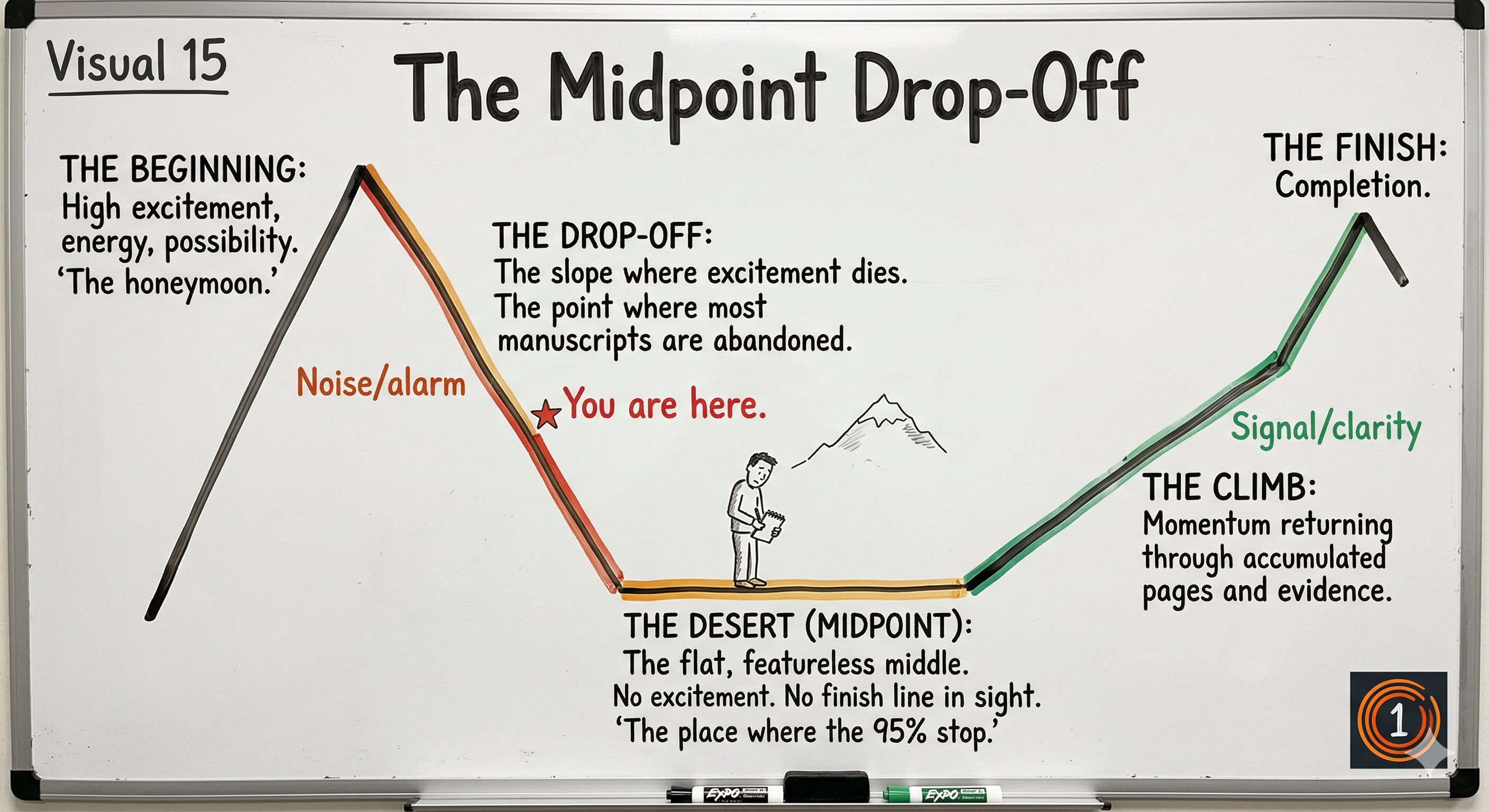
The new idea always arrives in the same place. Not at the beginning of a manuscript. Not at the end. Somewhere between page 80 and page 150 — the place we call the Drop-Off Zone in our work — when the project stops feeling like the book you imagined writing and starts feeling like the book you are actually writing. The gap between those two books is where the alarm fires.
Your nervous system reads that gap as failure. The thinking brain catalogs it as this idea is wrong or I've outgrown this story or the new one will be cleaner. None of those are honest names for what is happening. The honest name is: this is the part where the work gets hard, and the alarm has learned that escape feels like creativity.
The new idea is always the door. It is not inspiration. It is escape.
Three things about the avoidance loop nobody puts on a writing podcast
The pattern is older than your manuscripts. If you trace it backward, you will find it before the writing. The hobby you abandoned at month three. The relationship that ended when it asked you to be known. The job you left the week after the honeymoon period ended. The pattern is not a writing pattern. It is a finishing pattern. The manuscript is just the most recent room it has run in.
The new idea is rarely the wrong one. It is usually on the wrong day. Most of the new ideas that pull writers out of their current manuscripts are real ideas. They are usable ideas. They could be good books. The lie is not in the idea. The lie is in the timing — the alarm convincing you this one will be different, when the only thing different about the new idea is that it has not yet asked you to face page eighty-seven.
The cure is not "more discipline." Discipline is not a tool against the avoidance loop. Discipline is what the avoidance loop wears when it gets tired of being called undisciplined. Every writer in the 5% who finished did not discipline themselves into the last hundred pages. They learned to recognize the alarm in the moment it offered them a new idea, name it by its honest name, and write the next paragraph of the old book anyway.
Worth lives in Circle 1
Circle 1 Living teaches three concentric rings. Circle 3 is what you cannot control — what readers will think of the book, what reviewers will say, whether the algorithm will surface it. Circle 2 is what you influence — the people you show up for and the energy you bring when you do. Circle 1 is what you control — your effort, your attitude, your response when the alarm fires.
Worth lives in Circle 1. Nowhere else.
The new idea is a Circle 3 promise — the next book will be the one that finally proves you, that finally lands, that finally... Worth has never lived in the next book any more than it lives in this one. Every writer who has ever finished a novel finished it because they stopped negotiating with the alarm about which book to write and started writing the one already in front of them.
The 5% are not braver than you. They are not more "creative" than you. They have just gotten faster at recognizing the new idea for what it is — the door, not the answer.
What to do this week
Three moves, in order:
The first move is the Pattern Spotter. Twenty minutes. One page. Surface the specific behaviors the avoidance loop has run for you over the last ninety days. Not the feelings. The behaviors. The Tuesday you opened a new document. The Thursday you abandoned a chapter outline. The morning you bought a planner instead of writing. Naming the behaviors is what makes the pattern interruptable. The alarm cannot survive being seen on the page next to its receipts.
The second move is the masking-tape micro-milestone. Pick the manuscript you are avoiding. Identify the smallest possible action you can take in it tomorrow morning. Not "write the chapter." Not even "write a page." Smaller than that. Describe the room before anyone speaks. Sketch the protagonist's morning before the inciting event. Write one sentence of dialogue for the conversation you have been afraid to write. Write that single instruction on a strip of masking tape. Stick the tape to the lid of your laptop. The next time you sit down to write, the only goal is the sentence on the tape. Not the chapter. The sentence.
This is the move Ashley made in our work. She had fourteen abandoned manuscripts. The masking tape on her romcom said Describe the reception hall before anyone speaks. That was the chapter she had been running from for three weeks. She wrote thirty-seven words. Three sentences about a wedding reception at 11 PM with a wine stain on the tablecloth and a child sliding in socks. Her shoulders dropped. Her breathing slowed. The book got finished.
A note on size: the micro-milestone has to be small enough that your alarm does not negotiate with it. Three hundred words is not a micro-milestone. That is a floor. Your alarm will look at three hundred words and calculate whether you can do it before the laundry gets folded — and the alarm will win that math, because the alarm always wins when the stair is too tall. Make the stair small enough that the alarm does not bother negotiating. One paragraph. One image. The first sentence of the scene. Ridiculous-feeling smallness is how you know you've got it right.
The third move is the SPARK Persona Quiz. It will tell you whether your avoidance loop runs Adventurer alone, or whether it is running another mask underneath. Adventurer + Standard-Setter (you chase new starts and the ones you keep get strangled by perfectionism). Adventurer + Reserved (you generate ideas in private and share none of them). Adventurer + Provider (you start exciting projects and abandon them to help someone else's emergency). The combination matters. The mask underneath the mask is where the wiring lives.
Where this wound shows up next door
If the work you keep starting and not finishing is not a novel — a business, a degree, a relationship, a habit, a course you bought a few months ago — the same wiring is doing the same job. The universal version of this pattern, with scenarios from outside the writing life, is here: Why I keep starting things and never finishing →.
The closest cousin to the avoidance loop is the perfectionism trap — the writer who edits Chapter One eleven times instead of writing Chapter Two. Different mask, same alarm, same gap. Many writers run both at once. If both fire for you, Read: I can't stop rewriting Chapter One →.
Close
The novel you keep almost-finishing is not a wrong novel. It is the novel your alarm has run out of new ideas to escape into. The 5% who finish are the writers who stayed when the new idea arrived. They wrote the masking-tape sentence. They wrote the next sentence. They got to the end of the book that was already in their hands.
The fastest way to start that pattern in your own work is to surface it in writing.
Related: First time author advice nobody gives you →
If you would rather start with the diagnostic that names which mask your alarm is wearing, the SPARK Persona Quiz is three minutes, ten questions, and built specifically for this.
If you'd rather see the pattern in someone else first, the opening of Circle 1 for Authors is free →. Ashley's chapter — the one with the fourteen abandoned manuscripts — is one of the early ones.