Universal · Reason 02
You spent forty-five minutes this morning reading three articles about an election that is nine weeks away. Your kid asked for breakfast twice while you read. Your shoulders are still tight.
You stayed up last night replaying a conversation with your boss for the seventh time. You changed your wording in three of the seven re-runs. The conversation already happened.
Your daughter texted that she was "fine" at 9:47 PM. You read the message at 9:48. You have re-read it eleven times. You are reading it again.
You checked the weather app eight times yesterday. The forecast did not change. The trip was already booked.
You spent Sunday afternoon worrying about whether you said the right thing at the dinner party Friday. You cannot remember what you said. Neither can anyone else.
You wrote a list of all the things that could go wrong with the project on Monday. You did not work on the project on Monday.
You read seventeen reviews of a hotel before booking the room. You read three more after booking. Your stomach has not unclenched since you clicked confirm.
If your jaw is clenched, your hand is probably gripping the phone too. Notice both. Let them go.
We know. We have done every one of these. We have re-read a "fine" text from a teenager more times than is dignified to admit. So has most of the room of people who have ever cared about an outcome they did not fully control — which is to say, every adult who has ever cared about anything.
The question why do I worry about things I can't control is the most common form of low-grade exhaustion in modern adult life. It is also the wound that costs us the most untracked time. The honest names you have probably given it — I'm a careful person. I think things through. I'm responsible. I plan ahead. — are not entirely wrong. They are also not what is happening when the same loop runs for the seventh time about a conversation that is over.
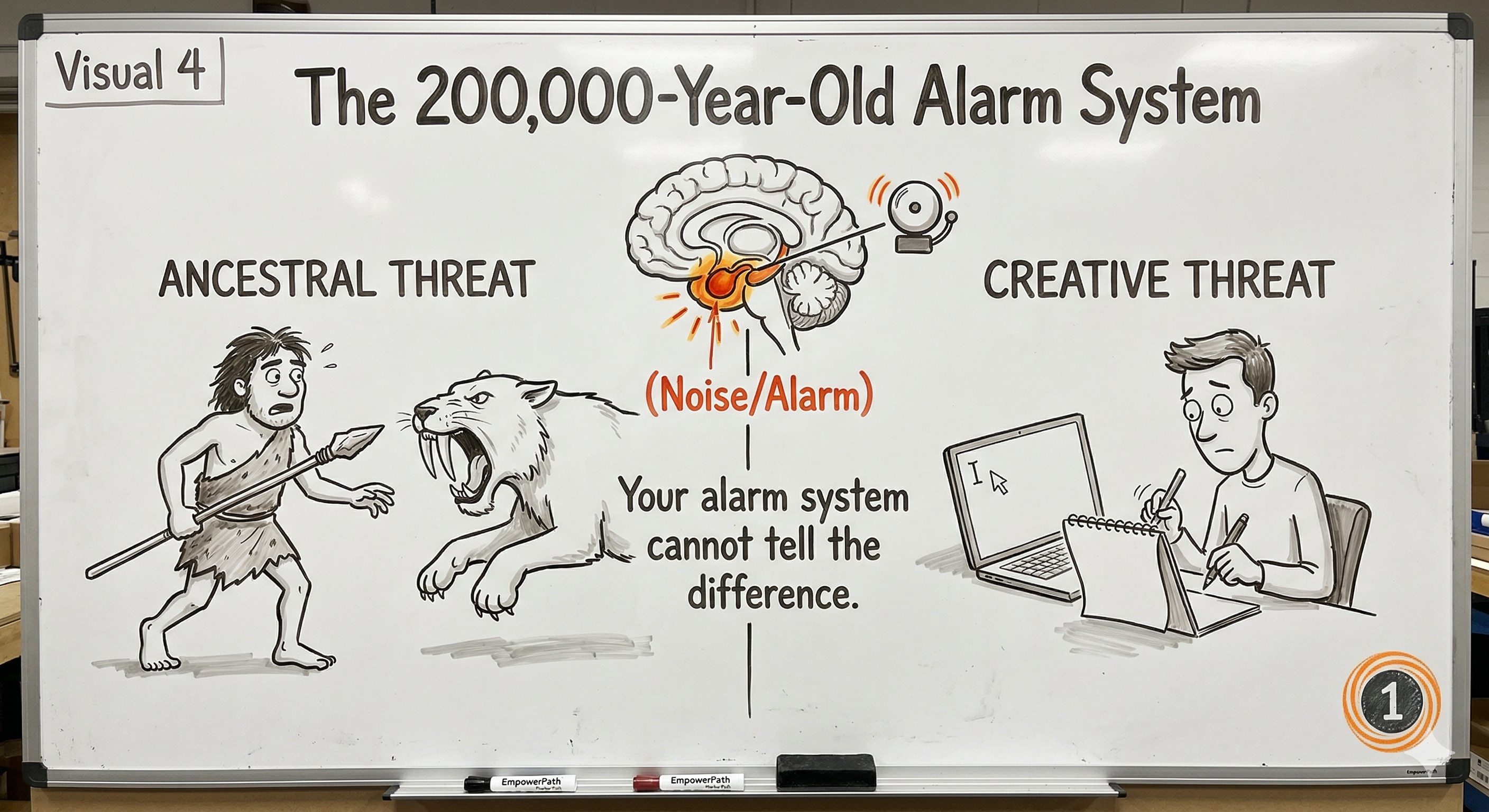
What is actually happening is your alarm.
The control trap is unusual — it can run in any costume
Most of the alarm patterns we name in Circle 1 for Authors run in one or two SPARK costumes. The control trap is different. It can fire in any of the five — and the costume changes how the worry shows up in your day.
Knight runs the control trap as argument. I'm going to argue with the news because someone has to. I'm going to draft seventeen replies in my head to a comment that wasn't even directed at me.
Reserved runs the control trap as private catastrophizing. I'm going to silently rehearse worst-case scenarios and tell no one. By the time I see her face I'll have predicted every possible reaction and pre-mourned the ones that hurt most.
Provider runs the control trap as overreach. I'm going to take responsibility for outcomes that aren't mine to own. I'm going to feel personally responsible for my adult kid's mood, my partner's stress, my colleague's deadline.
Standard-Setter runs the control trap as research. I'm going to read seventeen reviews. I'm going to make a spreadsheet. I'm going to optimize my way to certainty about something that cannot be made certain.
Adventurer runs the control trap as escape. I'm going to research a different approach to the problem instead of acting on the current one. The new approach has fewer unknowns because I haven't started living in it yet.
The mask matters less than the distinction the control trap blurs in all five — the distinction the Three Circles were built to make visible.
The Three Circles
This is the foundational framework of Circle 1 Living. It opens the book. It frames every tool that follows. It is also one of the most useful diagnostics that exists for adult worry.
Circle 3 is what you cannot control. The election. Your daughter's mood. Your boss's email tone. The weather. The hotel review someone else will write next week. Your sister's response time on a text. The market. The traffic. The way your mother said the thing she said on Sunday.
Circle 2 is what you influence. The relationships you show up for. The energy you bring into a room. The boundaries you set with the family member who calls at 11 PM. The work you put into a project. The conversations you choose to have or not have.
Circle 1 is what you control. Your effort. Your attitude. Your response when the alarm fires. The action you take in the next ten minutes. The boundary you actually enforce. The text you actually send. The chapter you actually finish.
Worth lives in Circle 1. Nowhere else.
The control trap's whole sales pitch is that Circle 3 is yours to manage. If I just worry harder, plan more, predict better, the outcomes will arrive favorable. They will not. Worry is not preparation. Worry mimics preparation. They feel similar in the body. They produce different results. Preparation acts on Circle 1 and lets Circle 3 do what Circle 3 does. Worry acts on Circle 3 and ignores Circle 1 entirely.
Three things about the control trap that don't show up in self-help books
Worry is not preparation. It mimics preparation. Both involve thinking carefully about a future situation. The difference is what you do with the thinking. Preparation generates a Circle 1 action and executes it. I'll send the email by 4 PM. I'll pack the bag tonight. I'll set the boundary with my mother on Sunday. Worry generates the same kind of cognitive output and never converts it to action. It just runs again tomorrow. The difference is mechanical, not moral.
The faster you can sort an item into Circle 1/2/3, the less time the alarm has to convince you the item is yours to fix. A worry that has been sitting in your chest for three days is a worry your alarm has had time to disguise as duty. If I'm not worrying about this, I must not care. The disguise dissolves when the worry hits a page and gets sorted. Election: Circle 3. Daughter's "fine" text: Circle 3. Conversation that already happened: Circle 3. The chapter I haven't started: Circle 1. Most of what your alarm has been calling responsibility is Circle 3 in a Circle 1 costume.
The cure is not "let go." That advice is everywhere and it is wrong. You cannot let go of a worry from a standing position. You can only redirect the same energy toward Circle 1 and watch the worry quiet on its own as the action takes the energy's place. Let go is a destination. Sort and act is the road.
What to do this week
Three moves, in order:
The first move is the SPARK Persona Quiz. Three minutes, ten questions. The control trap fires through whatever mask your alarm has put on, and the mask changes the form the worry takes. Knight readers will need different practical work than Provider readers. The quiz tells you which one to do first.
The second move is the Three Circles exercise. Take any worry you are carrying right now — the boss conversation, the daughter's text, the project, the news, the hotel review. Write it at the top of a blank page. Below it, draw three rings, smallest in the center. Decide which ring this worry belongs in. Then ask one question:
Is there a Circle 1 action available to me right now?
If yes — do that action in the next twenty minutes. The worry will quiet on its own as the action takes the energy's place.
If no — the worry is misfiled. It belongs in Circle 3, which means your alarm has been treating it as actionable when it isn't. The honest move is to write the worry on a sticky note, place the sticky note somewhere you can see it (the corner of a mirror, the side of the laptop), and physically separate the worry from the rest of your day. The worry is real. It is just not yours to act on. Naming that, in writing, is the most powerful Circle 1 action available for any Circle 3 worry.
Run the exercise once a day for a week. By Sunday you will have a list — physical, visible — of how much of your worry has been Circle 3 the entire time. The first time most people see the list, they sit with it for a long minute. That long minute is the practice. That long minute is what the alarm has been costing you, every day, for years.
The third move is the Pattern Spotter. Once the Three Circles exercise has surfaced the pattern, the Pattern Spotter is the one-page worksheet that surfaces the specific behaviors the control trap runs in your specific life. Twenty minutes of honest writing. The Tuesday you replayed the conversation. The Thursday you read seventeen reviews. The Sunday afternoon you spent worrying about a sentence you said on Friday that nobody else heard. The pattern cannot survive being seen on the page next to its receipts.
Where this wound shows up next door
If you are running this control trap inside a writing context — where the worry shows up as the eleventh edit on Chapter One because polishing the prose feels like managing the unmanageable response — the writer-form of this same alarm is here. Different surface, same wiring. Read: I can't stop rewriting Chapter One →.
The closest cousin to the control trap inside the universal hub is the perfectionism trap — same Circle 3 fixation, different costume. Where the control trap obsesses over situations, the perfectionism trap obsesses over outputs. Many people run both at once. Read: I can't stop perfecting it →.
Close
Your kid will text "fine." The election will happen on the date the calendar says. The boss will read the email and react however she reacts. The hotel will be what the hotel is. None of those outcomes are yours to draft, edit, or pre-approve — and the energy you are spending trying to is the energy that should have been spent on the chapter, the conversation, the boundary, the next ten minutes of your actual life. The 5% who finish what they start are the people who learned to act in Circle 1 and stopped arguing with Circle 3. The arguments did not improve. The arguers just got their lives back.
The fastest way to start is to find which mask your alarm is wearing.
If you'd rather start with a worksheet than a quiz, the Pattern Spotter → is one page, free, and built to surface the alarm in twenty minutes of honest writing.