Sarah sat in the parking garage for nine minutes, the exact amount of time it would have taken to drive to the coffee shop. Then she drove home. She would try again tomorrow. She always tried again tomorrow.
The engine was still running.
Sarah’s hands rested at ten and two, knuckles pale against the leather. The parking garage beneath her office building hummed its low electrical drone. The kind of sound that said go home, go anywhere, just go. Her laptop bag sat on the passenger seat like a dare. Inside it, three hundred pages of a leadership book she’d been writing for two years. Or not writing. Or writing and deleting and rewriting and deleting.
The coffee shop was nine minutes away. She’d timed it. Twice.
Her foot stayed on the brake.
The presentation that afternoon had gone well. Her VP had nodded three times during the stakeholder slide, which in corporate meant a standing ovation. Thirty-five minutes of flawless execution.
And here she sat. Foot on the brake. Nine minutes from the only thing she said she wanted.
Her phone buzzed. A text from her husband: Bedtime at 8. Spaghetti night. No rush.
No rush. Two free hours. Nothing standing between her and Chapter 8 except the ignition, the steering wheel, and whatever had cut the current between wanting and going.
She reached for the laptop bag, her hand stopping six inches from the zipper.
The manuscript inside that bag had a title page, a table of contents, and an outline so detailed it included estimated paragraph counts per section. What it did not have, after two years, was a finished draft.
She knew what the problem was. Discipline. She’d built a career on it, and somehow it never showed up for the book. That had to be it. What else could it be?
She let her hand drop and reached into her purse instead.
The flyer was folded into quarters along creases that had gone soft at the seams. She’d picked it up off the community board at the coffee shop the week before, between her latte and rushing to a meeting she was already late for. She’d told herself she grabbed it by accident. She’d told herself the same thing every time she’d unfolded it since.
She unfolded it now.
She read them once. Then again, slower. All seven. Some days all seven.
Her thumb went to the third one. It always went to the third one. What will people think of me when they read it? The crease across that line was the deepest, folded and unfolded until the paper had gone thin under her thumbnail.
She had registered on a Tuesday at 11:52 PM, three glasses of wine in, while her husband slept. The first session was tomorrow night.
She refolded the flyer along its creases and slid it back into her purse, where her hand would find it without looking.
Sarah turned off the engine. She did not drive to the coffee shop. She sat in the parking garage for another nine minutes, the exact amount of time it would have taken to get there, and then she drove home. Spaghetti night. Bedtime at eight. The laptop bag rode shotgun, untouched, zipper closed.
She would try again tomorrow. She always tried again tomorrow.
But now, she had somewhere to be and maybe a step closer to her dream.
The Room
Five chairs around one large oval table in the community room of the library. A whiteboard at the front, already half-covered in the facilitator’s handwriting. No podium. No stage. Just a woman in her mid-fifties with reading glasses pushed up on her head, already there when they arrived.
Sarah noticed the woman’s calm before she noticed her face. No hurry in her at all as the room filled, no glance at the door to see who was still coming. She tried to imagine being that unhurried in front of a room full of strangers. She could not. Something about that gap—between who she was and who this woman appeared to be—made her lean forward half an inch.
Sarah had taken the seat at the middle of the table, legal pad squared in front of her, pen uncapped. Keith claimed the far end, his back to the wall, arms crossed, eyes tracking the room for exits. Ruth sat nearest the door, coat zipped to her chin, hands pressed together in her lap. Patrick had arrived four minutes late, a dented travel mug in one hand, phone buzzing against his thigh. Ashley sat with one foot tucked under her, the other bouncing, her tote bag already spilling a notebook across the floor.
Nobody spoke. The floor lamp beside Keith’s chair flickered once and held.
Sarah clicked her pen. Click. Click. Click.
“Welcome to EmpowerPath,” the facilitator said. “Thank you for being here. I know what it cost you to walk in.”
Sarah’s hand moved without her permission into her purse and found the flyer, still there from the night before. Her fingers stilled around the soft creases.
“The flyer named seven thoughts that stop writers from finishing their manuscript. You read it, and instead of putting it down, you signed up. That is the only thing I need to know about any of you tonight.”
Patrick’s phone buzzed and he did not reach for it.
“I’m not going to promise you’ll leave here with the answer to those questions. That would be a lie. I’m going to promise you something harder. You will leave here knowing how to stop letting the alarm answer the questions for you. The rest is yours to write.”
She let that sit.
“Now. I’m going to teach you a philosophy called Circle 1 Living. But first, something about this workshop that most facilitators won’t say out loud.”
“I have been every person in this room.”
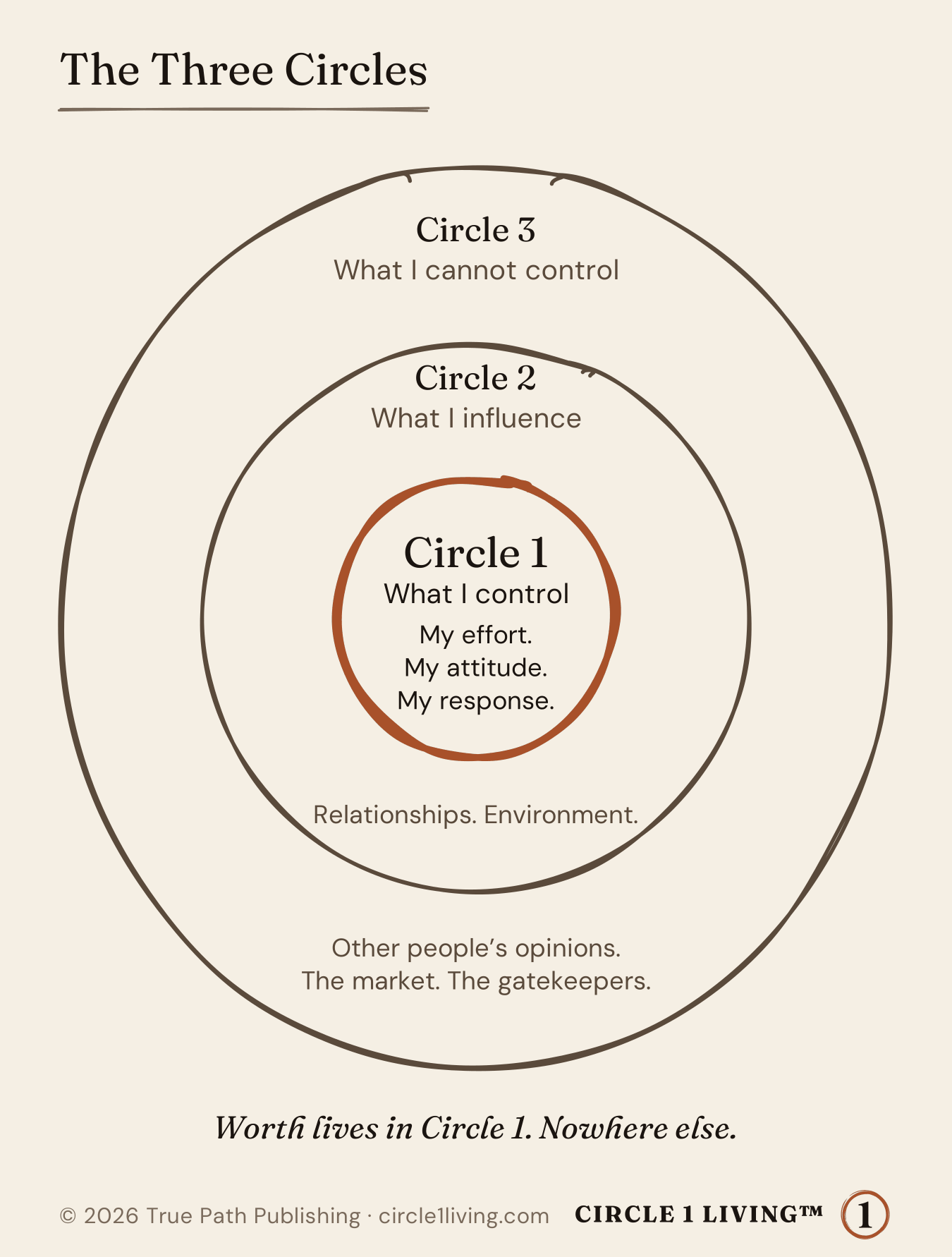
She let that land. Then she drew three concentric circles on the whiteboard.
She labeled the outer ring Circle 3: What I Cannot Control and started listing examples. Other people’s opinions. The market. The gatekeepers. Whether your mother-in-law reads Chapter 6 and calls you on a Sunday.
Keith shifted forward. “Look — so we accept it? Let the market do whatever it wants and sit here drawing circles?”
“What would you do instead?”
“Push back. You build a platform, you control the narrative. You don’t surrender to the gatekeepers.”
“Push back. Build the platform. Control the narrative.” She wrote each word on the board as she said it back to him. Then she turned, unhurried, nothing on her face but interest. “How much of your writing time went to that list?”
Keith opened his mouth. Closed it.
She labeled the middle ring. Circle 2: What I Influence. Relationships. Environment. “I’m not saying it’s wrong. I’m asking where it lives.” She tapped the ring. “Influence is real. But it is not control, and the distance between those two words has cost everyone in this room years of their lives.”
She pressed the marker hard against the board for the inner ring: Circle 1: What I Control. My effort. My attitude. My response.
She tapped the center.
“Worth lives here. Nowhere else. Circle 1.”
Keith’s arms did not uncross. But his weight settled back in the chair, half an inch.
“Only about five percent of the people who start writing a book ever finish it. That figure is directional, not clinical, but it is consistent enough to stop a room.”
She held up her hand before anyone could speak.
“It has nothing to do with talent. Nothing to do with time, or discipline, or degrees. The ninety-five percent who stop are not lazier than the five percent who finish.”
She looked at Sarah. “They are not less organized.”
She looked at Patrick. “They are not less generous.”
She looked at Ashley. “They are not less creative.”
She looked at Keith. “They are not less tough.”
She did not look at Ruth. Ruth’s hands pressed tighter in her lap.
Ashley’s foot went still. Five people held their breath.
“And some of the ninety-five percent were also fighting things the five percent never had to name. Money that ran out before the chapter did. A body that wouldn’t cooperate. A zip code that decided what they deserved before they opened their mouths. A system that treated their voice as an inconvenience before they’d written a word. None of that is an excuse. All of it is real. And pretending it isn’t helps no one in this room.”
Ruth’s eyes lifted from her hands. Only for a second.
“The five percent who finish found a way to handle what is happening in this room right now. In your bodies.”
The room went still.
“Before I say another word, I notice things. It is the job. If I name something and you would rather not answer, wave me off.”
“Sarah. Your pen has been clicking for ninety seconds. What is happening in your hand?”
Sarah looked down. Her thumb was white against the pen cap. She hadn’t heard herself clicking. “Tension. My — my fingers go tight when I don’t know what’s coming next.”
“Tight when you don’t know what’s coming,” the facilitator said. Sarah nodded.
“Patrick, your phone has buzzed three times. What happened in your neck each time?”
Patrick’s hand went to the back of his neck and pressed into the muscle there. “It locks up. Like someone put a hand on my shoulder and squeezed.”
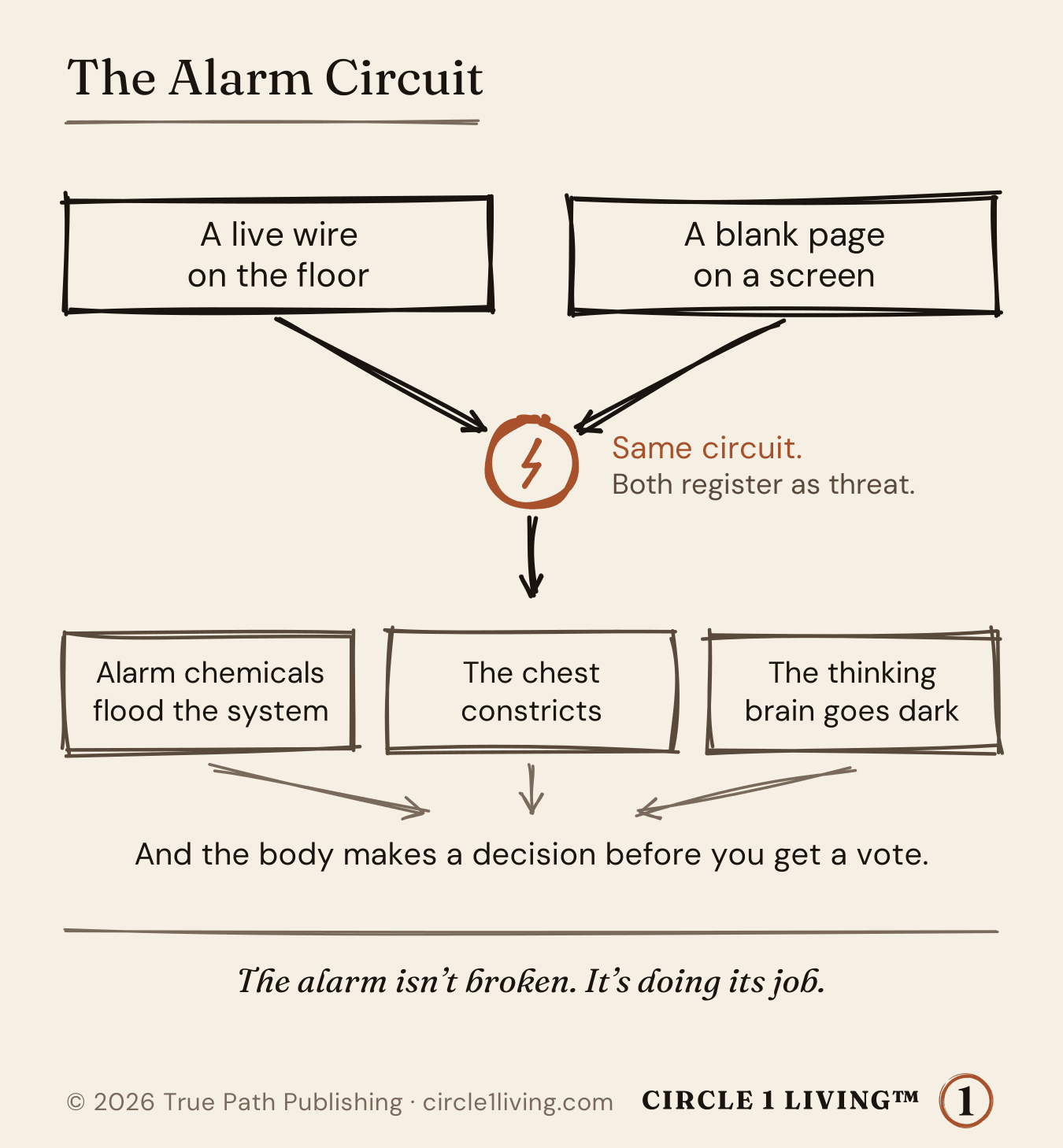
“That reaction,” the facilitator said, “is two hundred thousand years old. You are carrying an alarm system built for a world that vanished a hundred centuries ago. It cannot tell the difference between a predator in the grass and a blank page on a screen. Both register as threat. Both trip the same circuit: the body’s alarm chemicals flood the system, the chest constricts, the thinking brain goes dark. And the body makes a decision before you get a vote.”
“Where that alarm sends you when the work gets close to the bone is different for every person in this room. You will learn what yours does. Not tonight. Tonight it is enough to know it has been driving.”
“Here is the only rule of this workshop. The alarm isn’t broken. It’s doing its job. Every person in this room is carrying a nervous system that learned how to keep them safe when it first mattered. It kept someone safe once. The problem is that the alarm stayed on the job, and it never learned the difference between real danger and a difficult page.”
Sarah’s pen touched the legal pad. She wrote two words.
Circle 1.
Her shoulders settled half an inch. One long breath out through her nose.
It was not a revelation. It was a location. And for the first time in two years, she knew where she was standing. What had been driving — the name for it — was still out of reach. But tonight, for the first time, she knew there was a name.
✦
You are sitting somewhere right now. Your own version of the parking lot.
Maybe the light from this screen has been the only light in the room for longer than you planned.
Something in Sarah’s story hit a nerve, and you know which part. Not because you are Sarah, but because you have fourteen browser tabs open right now and not one of them is your manuscript. Because the heat that crawled up your neck when someone asked how the book was going had nothing to do with the room temperature.
You are not twenty-three with decades to figure this out. The window feels real because it is.
Whatever you have been calling it — laziness, lack of discipline, not wanting it enough — the diagnosis was wrong. This book will give you better words, one session at a time, in the order the wiring can hold.
You read the flyer too. Maybe a friend slid it across a table and watched your face when you got to the one you couldn’t read twice. You picked up this book anyway. That is the only thing this book needs to know about you.
You are about to meet five people who are carrying five versions of the same weight. You will see your own hesitation in their hands, your own excuses in their mouths, your own alarm firing behind their eyes.
Remember: Circle 1 Living
Worth does not live in the opinions of others. It does not live in your ability to influence outcomes. Worth lives in Circle 1: your effort, your response, your decision to show up.
Your next step (5 minutes)
Draw three concentric circles on whatever is near your hand. In the outer ring, write one thing about your writing life you cannot control. In the inner ring, write one thing you control right now. You are not planning. You are planting a flag.
Measure it: Signal Summary
Write one sentence: “The thing I control today is ___________.” Put it where you will see it tomorrow morning. The first flag is always the hardest. You planted yours.
✦
Sarah looked at the words Circle 1 on her legal pad. It was the first thing she had written in two years that she did not want to erase.
Her hand moved, again without her permission, into her purse and found the flyer with its soft creases. The third reason still folded sharper than the rest.
She left it where it was.
Sarah put pen to paper. Shift into drive.
End of the opening. The book continues for sixteen chapters, a side room at Garvey’s, and an epilogue.
You just met Sarah. You have not yet met Ruth, Keith, Patrick, and Ashley, or found out which one runs the same pattern you do. 150 writers read the full manuscript before it publishes on December 8. No cost. Claim a seat by November 8 and your name is in the printed first edition. The signed hardcover before anyone else.
Three minutes
Sarah is a Standard-Setter. The quiz tells you which of the five you are, and what to do about it. Take the SPARK Persona Quiz →